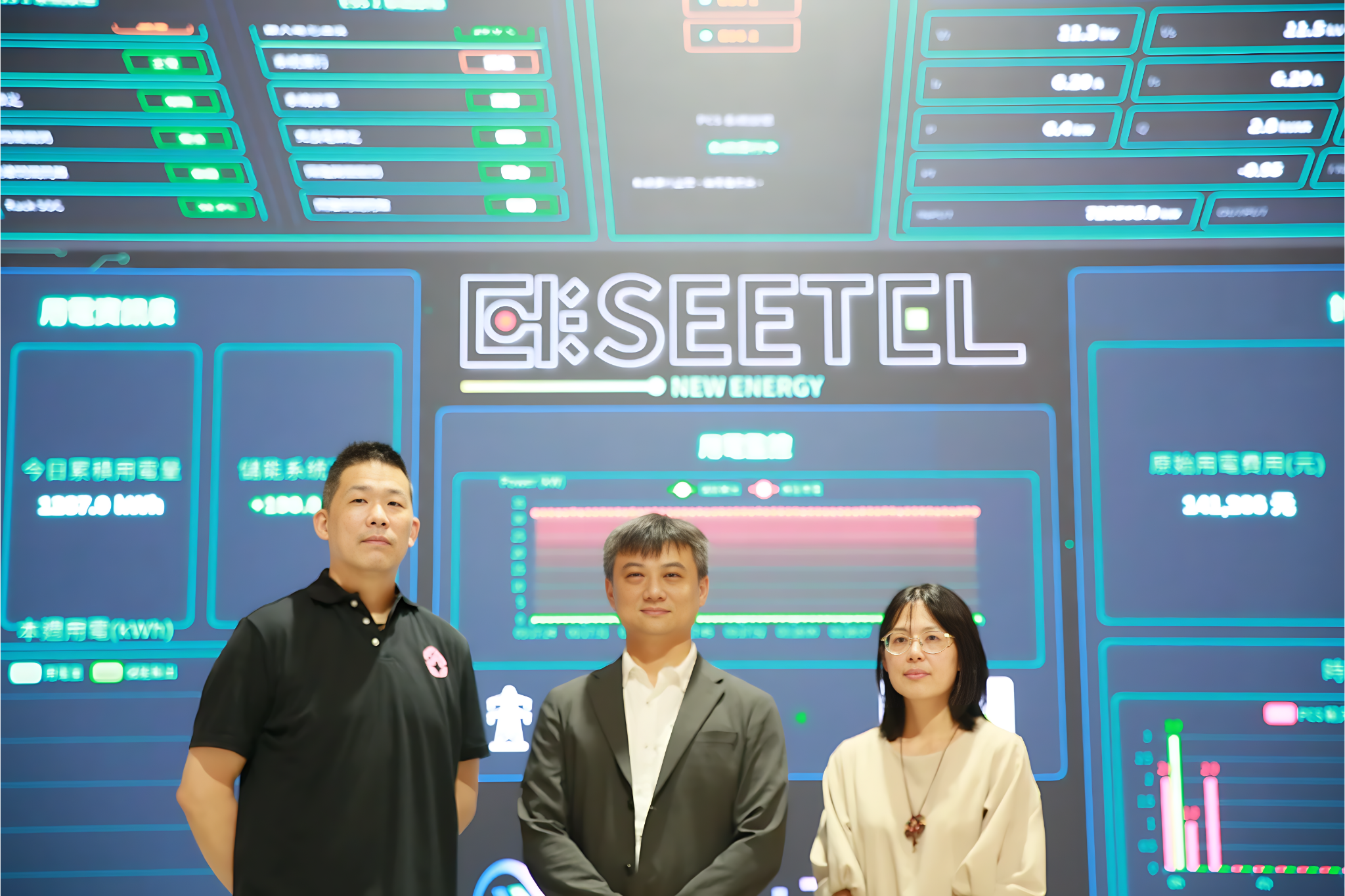
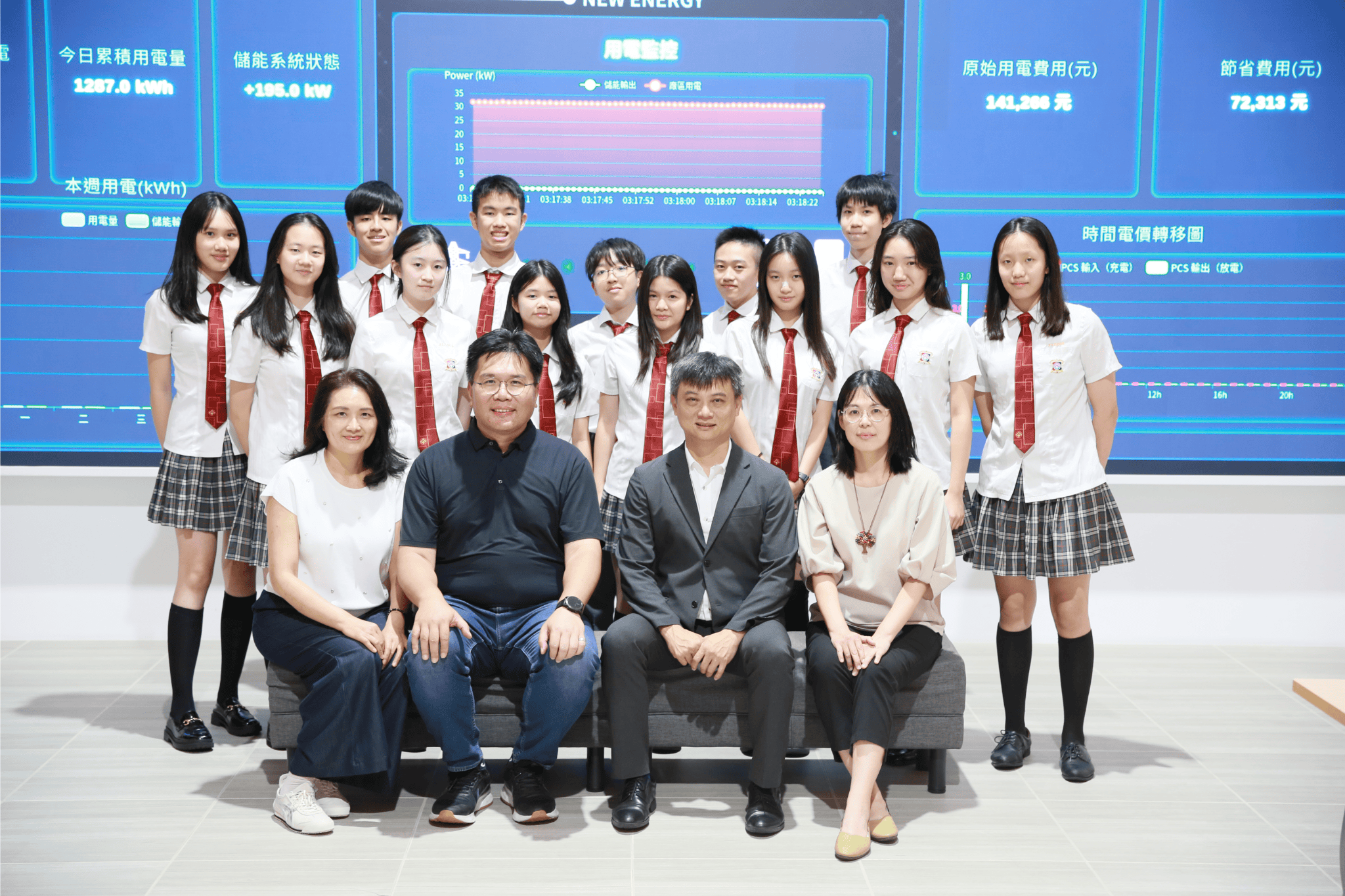
I have been working in the battery industry for more than 20 years. I started with Bluetooth products, then moved on to mobile phones, electric bicycles, and electric motorcycles, mainly focusing on traditional manufacturing equipment. These manufacturing systems are constantly being upgraded and replaced.
In recent years, I came into contact with Taipower’s FC (Frequency Control) services. The FC system has real-time regulation capabilities, similar to how computer systems require backup and resilience. In the past, Taiwan’s power grid was mainly mechanical, and since there was no renewable energy, there was no need for energy storage or regulation.
However, due to the growing emphasis on ESG, society now aims to reduce the use of fossil fuels while electricity demand continues to rise. Renewable energy sources such as solar and wind power are inherently unstable and intermittent. Therefore, energy storage systems play a critical role at this stage. They can regulate electricity, support testing and data analysis, and strengthen the resilience and stability of the power grid.
For these reasons, I believe energy storage is a highly promising industry, and our company has chosen to move in this direction.
When it comes to the core philosophy of running a company, I like to describe it with a Taiwanese saying: fairness and merit are important, but action matters most.
In many workplaces, people discuss numerous ideas and concepts, yet only a few are truly willing to take action and execute them. I hope my team can work alongside me and actually put ideas into practice.
It’s like wanting to go to Sun Moon Lake—if you only think about it but never take action or practice, you will never reach your destination. However, when a team works together toward a shared goal, achieving it becomes not only a success but also a deeply moving experience.
We all know that Taiwan faces power shortages, but I wouldn’t say that our company directly “assists” the government. Our original goal was quite simple—to sustain the company, make a profit, and secure projects.
Fortunately, Taipower introduced a PPP (Public-Private Partnership) policy, which allows private companies to receive reasonable investment returns. Our team worked extremely hard, overcoming civil and electromechanical constraints, installing battery systems, and participating in Taipower’s power dispatch operations. As a result, the company became profitable.
Since planning and design are our core strengths, we retain control over all key systems. In February and May of last year, we ranked first on Taipower’s trading platform. This achievement would not have been possible without the government’s private trading platform and our team’s persistence in solving problems and overcoming challenges.
From my perspective, a personnel management system is essentially the simplest form of automation. It's like going to an ATM. When you withdraw money, do you need 0.1 seconds to get the cash? Even so, some procedures are required; it might take 10 or 15 seconds. So, the first thing we need is stability. Secondly, we need the equipment to withdraw money from an ATM, but we don't need it. If it malfunctions or breaks down, then we need to predict what will happen. Of course, with automation and AI integration, we can make predictions. For instance, if we know tomorrow will be sunny, we can charge our batteries more today and more tomorrow. But if we predict tomorrow will be rainy, we know we won't need to charge as much, so we'll charge less. Therefore, because the entire environment operates very quickly, we need more information about the surroundings and future needs, which allows us to make such predictions and plans. Therefore, for me, this kind of thing might be what Schneider Electric called PLC automation 20 years ago, or what PLC automation was 10 years ago, but now it's still called PLC, and it still controls a few Ols, that is, a few inputs and outputs. The control is still fixed. But how does it improve? It's because it can predict the next potential loss or the next expected situation, so it can avoid it early. For instance, when we're using tires, we know the pressure, and when the pressure reaches a certain level, we know what the car should do first. The same goes for batteries. Batteries have full charge and discharge cycles, and they have DODs. To maintain a certain signal, it can't accept an immediate power outage; I want to maintain the system's operation. Thus, I might reduce the load and then use it. Therefore, for me, the first point is a bit niche; it's an automation, a loop-avoidance system. We just need to add many sensors to control and prevent the situations we might encounter.
The first point is having your own BMS. If we have bought someone else's system, it will be very difficult to control their battery management system. For example, if I want it to discharge, I won't be able to control it. If the system could only control one area, you wouldn't be able to achieve your ultimate goal. Yet, if you could control every part of the system, it would be much more complete. As for AI, to me, it is a more complex, more sophisticated, and smarter system. You can do more than just internal self-protection and external protection. You can also incorporate air quality, weather conditions, and various judgments. Therefore, to me, it's like a fusion, only the software couldn't be this smart before. Nowadays, software and hardware development are intertwined, operating together. For instance, hardware development must complement software, unlike traditional systems, where hardware only does hardware. Right now, these two are just like twins. The collaboration between software and hardware is somewhat like a duo, just like when we dance. The trace and dance moves are actually the same. When I move forward, and when I spin, that's another part, a module. I'm not good at describing it, but for me, it's like a duo. We must own our own BMS. Nevertheless, because we can do both, they can be AI-enabled. If one side stops moving, only the other side is controllable, but it's somewhat flexible. No matter what you say or do, it just won't move. Therefore, this kind of multidimensional, current generation requires every part, every finger, and every joint to be able to engage. The more you control, the more functional your system and your AI become. Same idea, the fewer items you control, the less functional you are.
Firstly, due to the fact that we are a private business, we will need to conduct soil testing and an architect's assessment before installing our equipment. After the equipment is installed, all the hanging decorations must first pass Taipower's communication and capacity tests. The tests can only be put online after the meeting. Before going online, there are many different regulations. For instance, the inner ring of the electrical system must be less than ten times the outer ring's resistance. Our standard is less than four times the resistance, because we believe that the lower the grounding impedance of our electrical equipment can solve problems. Therefore, regardless of whether it's a conventional or AC vehicle, we want the grounding impedance to be less than four ohms. Yes, but four ohms isn't the end. Afterwards, once the equipment is up and running, you need to test its HY, also known as the hybrid impedance. Currently, in our factory, the factory-installed equipment has a tolerance of around 1500 to 3000 ohms. Thus, after the equipment is tested and the entire circuit is completed, we will need to ask Teclast to perform communication capability testing. Only after the test is completed will it issue an "OK" signal, and only then will Teclast power on the equipment. In conclusion, there is a specific logic involved.
Currently, in the overall green energy ecosystem, some solar panels have been blown away by typhoons, resulting in longer power generation times. Yet, we are still discussing power generation products with GE, a gas-fired power plant company. Thermal power plants take at least 30 minutes to start up, due to combustion and other factors. Therefore, I firmly agree that energy storage is currently the fastest energy source, as its response time from 0 to 1 is only 0.1 seconds. We will be able to react within 100ms. Furthermore, energy storage offers better regulation and utilization. For example, we currently have hydropower and thermal power generation. Taiwan requires that mechanical power generation should be 15%, but due to current power shortages in Taiwan, you often see mechanical power generation dropping to 6% or 5%. However, at this point, our energy storage capacity, in Taiwan, is 1: 2.5's 1: 2 change to 1:6, meaning that for every hour of power generation we use, we have a 6 hour energy storage system as a backup, the effect might be that, for example, if there is a power outage in the northern or central regions, because we have a 1:6 backup, we can meet the current power shortage for most equipment during immediate power generation. Therefore, the power supply to equipment will not drop below 15%, but may increase from 5% to 8% to 10%. Thus, I currently believe that energy storage is still one of the most important components in the system.
Beyond these issues, and in all our planning and design, going back to what I've just mentioned, the more sensors we have, the more things we will be able to monitor, which will allow us to better we can predict the stability of our environment. Therefore, we invest heavily in sensors, such as fire detection, temperature sensing, voltage sensing, and current sensing, including mutual inductance. In many places, we might not just use one connection for sensing, but two connections. There are also various temperature sensors. For instance, the voltage range we usually see looks like this. If one day a wire suddenly drops or rises, you can predict whether there's a problem and pinpoint the stable point. Therefore, in fire detection and fire protection models, our strategy is to use sensors as much as possible, increasing the number of sensors to avoid human error. Due to that, sometimes, seeing a dense array of data, like the voltage of 6000 batteries, is less intuitive than seeing a single, unexpected failure. For instance, 1500 volts requires 1000 batteries. Let's imagine we need 1000 batteries. In a three-legged race, everyone moves forward in a 1-2-1-2 pattern. But with 1000 people, it's 1000 people on one leg, so everyone's steps need to be more monitored. If I only observe everyone taking the correct steps, it's not easy to find a stable point. Yet, if I can detect anomalies using sensors, like someone having a stomachache or twisting their ankle, my device can predict and immediately correct the steps, preventing mishaps.
Regarding the company's development, given the current situation in Taiwan due to the issues with TSMC and NVIDIA, our GDP suppressed South Korea's last week — a feat that took 22 years to achieve. For me, this development is thanks to TSMC's manufacturing processes and NVIDIA's technology. Therefore, my future goal is to work closer to these companies. The company is indeed focusing on development in ITC redundancy, BPU, and the utilization of TSMC's facilities. The way that we build a redundancy system for TSMC is a key direction for the entire company. Regarding talent within the company, we are collaborating with the National Taiwan University (NTU) Cultural and Creative Industries Area and with National Central University (NCNU) on a personnel management system. We hope to work with university faculty and students, as the market is constantly changing, to collaborate on courses and implement new technologies, electronics, and ideas. For instance, in my collaboration with the NTU racing team, I noticed they no longer have mass-produced batteries, which saddened me. My goal is to help students find a competitive battery and apply it to their vehicles. So, my first point is that we need to be proactive; everyone needs to be involved. Having ideas alone is useless. We need to develop practical skills — physical involvement and hands-on-experience. Therefore, I hope to use my experience as a model to encourage more people to participate in our endeavors. Thank you.
I've been working with the National Taiwan University (NTU) racing team for four years. The first year, a group of students came to me about their batteries and what had happened. Because I didn't have enough resources at the time, I asked them to contact manufacturer A and manufacturer B for specific tasks. Since we had established connections, I was able to resolve the students' problem. During the second year, the students came to me again and requested their progress for the following year. Since my company had more resources that year, I said I would help them to get some batteries from manufacturer X, and I would help them plan specific steps.
In the third year, I told the teachers that the interaction between students and us wasn't enough. I thought we should find a group of passionate students to do something together. Professor Chang from National Taiwan University had this idea, so I decided to start a course using unmanned vehicle concepts to attract students. In less than twenty days, we found about eighteen students. Now it's the second year, and we've developed an unmanned vehicle center. We're currently collaborating with the government. For example, Chenxi invests 10 million NT dollars annually, and the government also invests 10 million NT dollars annually. Therefore, over three years, the university can receive about 60 million NT dollars in collaborative funding. I hope that through this project and production, everyone will be willing to get involved and learn more.
We just saw these two topics. One is our cross-domain testing. In cross-domain testing, we disassemble the entire cross-domain testing process and then reassemble it. However, since we don't use anything made in mainland China, we will reverse engineer everything and manufacture these parts locally in Taiwan. The second is the larger-scale HV (High-Vehicle Vehicle). The two major issues are that Taiwan hasn't conducted research on these large vehicles, and the second difficulty is the durability of 50 to 60 tons. To ensure that it can withstand 50 and 60 tons, this requires design, planning, and algorithms.
We will not reuse the disassembled batteries. However, for frequency-modulated energy storage, if we plan to use them in remote areas such as mountains or schools, solar cells are very suitable. Our batteries may have a lifespan of 15 years. Even if some devices have only been used for about 5 years, they still have some residual capacity. We can use these batteries for a second phase of application. Therefore, remote areas, or relatively remote Wi-Fi 5G stations, are very suitable for this kind of utilization.
Globally, there's no such trend; pro-independence sentiment is very strong globally. Because if we're targeting Taiwan's symptoms, the first thing we can do is let the issue escalate. Therefore, we are currently continuing to develop this approach in the U.S. and Japan. Thank you.
Q: Okay, the chairman has just shared with us the future development of Seetel in the energy storage industry. Now, as members of this generation, we often hear the topic of sustainable development. So, how are these environmental protection and sustainable development concepts put into practice in actual businesses? Today, we are very pleased to have Mr. Wen, the company's CSO (Chief Sustainability Officer), to talk about your company's efforts and practices in sustainable management. Many companies and organizations today advocate sustainable development, but in the energy storage industry, sustainability is not just about carbon reduction; it also involves battery recycling and supply chain requirements, among other things. Among these many goals, how does your company establish its own sustainability strategy?
CSO Wen: First of all, thank you for the question. It should be said that our energy storage industry has always been on the path to sustainability. Regarding sustainability policy, the first point we can discuss is the product lifecycle, because sustainability is about the circular economy of products. As you can see, our group started with the energy storage design at AUROSI, all the way to the assembly of the energy storage cabinets, then to the engineering construction at Seetel, and finally, the maintenance and operation of the entire project site. In fact, the battery's lifecycle accounts for about 90% of the entire product's lifecycle. Therefore, within this cycle, we are making the most effective and maximum use of the batteries, which is precisely how we implement sustainability.
Secondly, besides our own group's commitment to sustainability, we also extend this commitment to our suppliers' supply chains. We ask our suppliers to sign sustainability pledges, promising not to use environmentally harmful raw materials and to uphold human rights. They must work with us to implement sustainability principles.
Furthermore, regarding this social responsibility issue in the energy sector, you can see that our chairman has previously emphasized our corporate philosophy, mentioning numerous industry-academia collaborations. Therefore, in energy education, we hope to extend our reach to academia. Besides industry-academia collaboration, we will also work with the community, hoping to integrate energy education into basic education. Thank you.
Q: Sustainability can easily become just a slogan in today's society, but the key lies in its implementation and long-term tracking. What methods does your company use to ensure your strategies achieve long-term development when setting sustainability goals?
CSO Wen: Okay, so we've discussed sustainability before. Sustainability can easily become just a slogan. In reality, we often encounter situations in the industry where employees want to pursue sustainability, but management doesn't because sustainability is something that only shows results over a long period. Most companies are profit-driven when it comes to sustainability, and in practice, it often requires significant financial investment. I think the greatest difficulty lies in the fact that many companies can't truly achieve sustainability and only superficially address it; that's because senior management doesn't support sustainability efforts.
As you can see, our company's founders have always been committed to sustainability, and this is consistently supported in our core culture. Therefore, I believe our company's sustainability policy is sustainable for long-term development. In practice, the key is how to track our sustainability efforts over the long term. Since Seetel went public this year, we will begin preparing our sustainability report next year. This report will include a carbon inventory, allowing us to review our carbon reduction efforts annually. This also provides a platform for public oversight; the public will be able to download our sustainability report from our website to see if our company has consistently implemented sustainability measures.
However, I think this is because it has been integrated into our corporate culture, so I don't think we need to worry about this aspect. In the long term, the target should be net-zero carbon emissions by 2050, set by our government, so our goal is also set at net-zero by 2050, but we hope to achieve this goal as early as possible.
When setting sustainability goals, what approaches does your company use to ensure that its strategy supports long-term development?
Development means that this year, we established the Sustainability Promotion Team, and we may upgrade it further to form a Sustainability Committee. Within the team, we will implement initiatives in three areas: environment, society, and governance. Each team has its own goals: environmentally, how to reduce carbon emissions; socially, this includes contributing to social responsibility and achieving employee well-being by becoming a happy company and providing better benefits; and in terms of governance, it's about improving company operations, with board oversight, etc.
Therefore, under the supervision of the sustainability team, this aspect is reported to the board of directors regularly. This is how we implement our long-term development strategy. Thank you.
問:好,那剛剛董事長已經與我們分享了熙特爾公司在儲能產業未來的發展,那接下來身為這個世代的我們,耳邊常常環繞著永續發展的這個議題,那請問在實際的企業中這些環保或是永續發展這些理念要如何被實踐呢?那今天非常高興邀請到貴公司的溫永續長來與我們談談貴公司在永續管理上的付出與實踐。當代許多企業與組織都在倡導永續發展,但在儲能產業中,永續不僅僅是減碳,同時也涉及電池的回收以及供應鏈需求等等,請問在眾多目標中,貴公司是如何建立自己的永續策略的?
永續長: 首先謝謝主持人的提問。應該是說我們儲能產業一直都在永續的路上,所以應該是說實行我們的本業就是一直在做永續這件事。那在永續的政策上面,第一點我們可以先討論到產品的生命週期,因為永續講的就是產品的迴圈經濟。那可以看到我們集團從辰熙的儲能設計開始,一路到儲能櫃的組裝,後到熙特爾這邊的工程建設,及後續整個案場的維運完畢。其實這整個產品的電池的生命週期,應該在整個週期裡面它已經佔了大概 90%,所以在這個循環的這個週期裡面,等於是我們將電池做最有效最大的運用,就是在執行這個永續這樣的執行。
那第二點就是說,除了我們自己這個集團本身在做永續之外,我們也會向外、向上推廣到這個供應商的供應鏈這邊一起做永續。所以像我們合作的供應商,都會請他們簽署永續的承諾書,那在永續方面就是說要請他們承諾不會使用傷害環境的原料,還有在人權的尊重上面,這個都要跟我們一起執行永續這個部分。
另外就是在這個能源的這個社會責任事件上面,可以看到我們董事長之前就在企業理念上面,就是說我們這個有做很多這個產學合作這樣子的實踐。所以我們其實在能源教育方面,我們其實就是希望能夠推廣到學界。那除了產學合作之外,當然也會跟社區這邊結合,就是希望是能源的部分能夠紮根到這個基礎教育裡面這樣子。謝謝。
問:永續在當今社會中很容易淪為口號,但關鍵在於是否能實踐以及是否能長期追蹤。請問貴公司在制定永續目標時,有什麼方法來使自己的策略能夠達成長程發展?
永續長: 好,應該是說前面有講到說永續,永續會淪為一個口號,那其實在業界我們遇到的很多實際的狀態,就是即使員工想要做永續,但是老闆不想,因為永續這件事情是一個長期才能夠看到效應的這個。應該說永續的部分,公司大部分是以盈利為目的吧,那在永續的實踐上,其實在很多時候必須要花費蠻多錢的。那這個我覺得最大的困難在於說,很多公司沒辦法實現永續,而且會只是做做表面的情況,那個是高層沒有支援永續這件事。
那大家可以看到我們公司的話,在創辦人的部分一路以來都是走在永續的路上,那在我們公司核心文化裡面,我們也是持續地支援永續這件事。所以我覺得以我們公司的永續政策來講,是可以長期發展。那在實際面的話,就是如何長期追蹤我們有沒有做到永續,因為我們從今年開始,因為熙特爾是今年上市,所以在明年就會開始做這個永續報告書。那永續報告書的部分,就是我們會有實施碳盤查,那碳盤查的話就是每年都可以看看公司減碳的狀態,那這個也是可以大家給我們一些監督,那就是大眾也可以從網站上都下載到我們的永續報告書,來看看我們公司在永續面的部分有沒有長期的持續實施。
那但是我覺得這一點就是因為它已經升值我們企業文化了,所以我覺得在這個部分是不用擔心這樣子。那長期追蹤的話,應該是由我們行政院政府的 2050 淨零排碳,所以我們的目標也是設定為 2050 淨零,但是希望能夠更早地達到這個目標。
請問貴公司在制定永續目標時,有什麼方式來使自己的策略能夠達成長程發展嗎?
發展就是說,我們在今年就是成立了這個永續推廣小組,那後續可能再升級,就會成立永續委員會。那小組方面,我們就會有分成環境、社會跟治理三個方面來推行。那其實我們在各個小組裡面,我們都有設定自己的目標,就是環境面如何減碳;社會面的話就包含說一些社會責任的貢獻,跟員工就是如何達到,如何成為幸福企業、如何讓員工得到更好的福利;那治理面的話,就是如何將公司經營得更加完善,有董事會的監督等等。
所以應該是說,在永續小組的監督下,那這個部分也都是定期會跟董事會報告,所以這個長期的發展來講,我們是用這樣的方式來執行。謝謝。