Q1: What was the company’s original intention behind its founding? And what are the specific goals and visions that are established?
Regarding the problem of marine plastic pollution, it is well known that the situation is worsening. We plan to recycle abandoned fish nets, convert them into nylon pellets, and utilize them to manufacture new nets. Besides achieving a circular economy, we can also provide a solution to protect our marine environment, not just a commercial activity. We hope to demonstrate our social responsibility and commitment to environmental protection, and inspire other businesses to follow this path. This is our original intention.
Q2: Has the company faced challenges during the founding process? How were the obstacles overcome, and how is the plastic industry transforming into sustainable management?
Ok, I will divide this into several aspects to explain. Firstly, the instability of fish net resources needs to be addressed; therefore, we collaborate with the fishermen’s association, the local government, and government agencies to establish this recycling network. To ensure quality supervision, we have invested in research and development and established our investigation team. Then, based on the classification, drying or removing impurities to researched and developed to enhance the quality of raw material. On the aspect of transportation, we also hope to localize the process. Taiwan is a small island, so it's actually easy to handle the transportation problem in the northern, middle, southern, and eastern areas. However, why do we need to expand into Southeast Asia, Vietnam, and Thailand? Firstly, we can secure access to the marine waste fish net resources in Southeast Asia. Therefore, we can start the process instantly, whether it’s from Vietnam or Thailand. Once we receive the fish net, we have the equipment there, and we can immediately process them with the same production equipment as in Taiwan, turning them into pellets directly on site. This is the first part. Another major challenge is that many people think that recycled materials are unstable in quality; they will think that:” that’s made from cheap materials, unstable in quality, and inferior in performance.” Then, how to change their impression? That’s based on the experience of our investigation and research team. We’ve already started recycling fish nets 20 years ago, so we have 20 years of experience to understand what the quality of performance the customers want, and what quality of the material can satisfy the customers. This understanding is what we have built in these 20 years of experience. This long-term knowledge is one of our key advantages. We also hope to collaborate with industry, government, and academia because achieving a true circular economy cannot be done by just a few companies; it requires cooperation across all three sectors. The most serious challenge we face is market acceptance and promotion. Consumers often have doubts about recycled materials and do not fully understand their value. This is why we need to improve quality control and material properties, so we can reassure customers about reliability. The purchase habits of companies and customers will increase the difficulties in promoting carbon reduction and recycling. Many people will think environmental protection is a slogan, or assume companies only engage in these initiatives for profit. Of course, to survive, a company must have profit, but beyond that, we want to give greater meaning to consumer behavior. This is also why we apply for international certifications, we can reassure our clients, to prove that our recycled material has international certifications, and its source is traceable, the quality of the material can be well controlled, so the consumers are willing to pay a slightly higher price for recycled material. In conclusion, these are the obstacles we face during the entrepreneurial process, as well as the solutions we work on.
Q3: What positive effects do you hope this industry can bring to society?
We hope to start from “idea” to “item”, then what is “idea to item”? Firstly, you need to have an idea of environmental protection and a circular economy. Once we have the idea, we collaborate with brands and manufacturers to develop products that can really reduce carbon emissions and waste products. Then let these eco-friendly products be applied to daily life; you can only do this in order to achieve the goal of plastic and carbon reduction. From “idea” to” item” to practice. We hope that environmental sustainability can be promoted consistently. Besides reducing marine waste and utilizing resources, we need to drive and raise public awareness on environmental protection, so the customers are willing to say, “I can actually help the environment and ocean through buying this marine waste.”
Q4: How do you view the role and potential development of “marine waste recycling” in the sustainable industry?
In the sustainable industry, it practically improves marine ecosystems, reduces plastic pollution in the environment. Firstly, we divided it into three aspects, we hope that its application is diversified, although it is a single material. I called it a marine waste fishing net, but I can make it into many different kinds of products. We hope the application is diversified and increases the value of this recycled material. The second is about market demand and promoting brand value, and because many large enterprises commit, they hope to raise the proportion of recycled materials in their product. For example, the European Union has set a regulation that the proportion of recycled material used in a car needs to be at least 25%, of this 25% needs to have 7% of material recycled from waste cars. There must be promotion from government laws and policies; only then can we make this thing happen. Simply put the support from government policies, the cooperation from enterprises, and social participation are crucial factors to promote the recycling of marine waste product into sustainable development, these are the three main factors.
Q5: How does the company perform product promotion and raise public awareness of ocean-related reuse?
I think this question is very good, it is more practical, like what should we actually do? Firstly, we will use news reports to tell our stories, for example, through your organization or news station, to do some interviews and some videos. Like posting on social media or an interview, we try to let the public understand our story, our characteristics, and what we are going through. These actions are mainly made to acknowledge the customer.
Q6: What innovative technology has your company used in manufacturing plastic to reach the goal of reducing carbon emissions or raising energy efficiency? It doesn’t necessarily have to be classified technology.
Honesty, our technique is not innovative because we are using a physical method to do this. Physical methods are easy to perform and cheaper than chemical methods, so many people can use them. Instead of focusing on 'innovative technology,' we are concentrating on improving quality control and physical properties, as the recycled material has only 70-80% of the quality of the new material. However, the brand owner will not lower their standard; they will definitely demand that you make the material as good as the original new material. Therefore, how do I take material that has 70% of the original physical properties to boost it to the full 100% capacity of the new material? That is our technology.
Q7: What exactly is the difference between your company’s ocean-waste plastic nylons and other plastic materials, such as Nylon 6 and Nylon 66?
The material of the ocean-waste fishing net is called Nylon 6. Our other product, for example, Nylon 66 and other composite materials, Nylon plus ABS, or other Polyamide. There are many different materials in the Nylon family, such as Nylon 610, Nylon 12, Nylon 9t, and the main difference for Nylon 6 is in the heat distortion temperature and the stiffness. Nylon 6 has a higher viscosity. Therefore, the rigidity of the product is better than Nylon 66 and other materials. Do different products use different plastics or the same plastics for all of them?We look at the properties of the client’s product to provide them with the right material. Something can only be made with Nylon 66 and is not suitable with Nylon 6. In that case, we will tell them this might not be suitable for the fishing net material; however, if you still want to use the fishing net in your product, we will inevitably have to modify the product, property enhancement, and composite material work before you can use it. The main difference lies in the difference between basic physical properties. However, it is possible to transform it into the same product. Let me give you an example, such as a telephone; its original material is Nylon 66, but can Nylon 6 used to make fishing nets can be used to make telephones? It can, but I would inevitably need to modify it. I might need to add some glass fiber and a Toughening agent to make its physical properties closer to those of Nylon 66. Only then can the material be used. In terms of application, it still depends on the specific needs of each industry, and then we make the necessary adjustments and settings.
Q8: What are some of the most representative products the company currently has? Could you share one or two of them, as well as their impact?
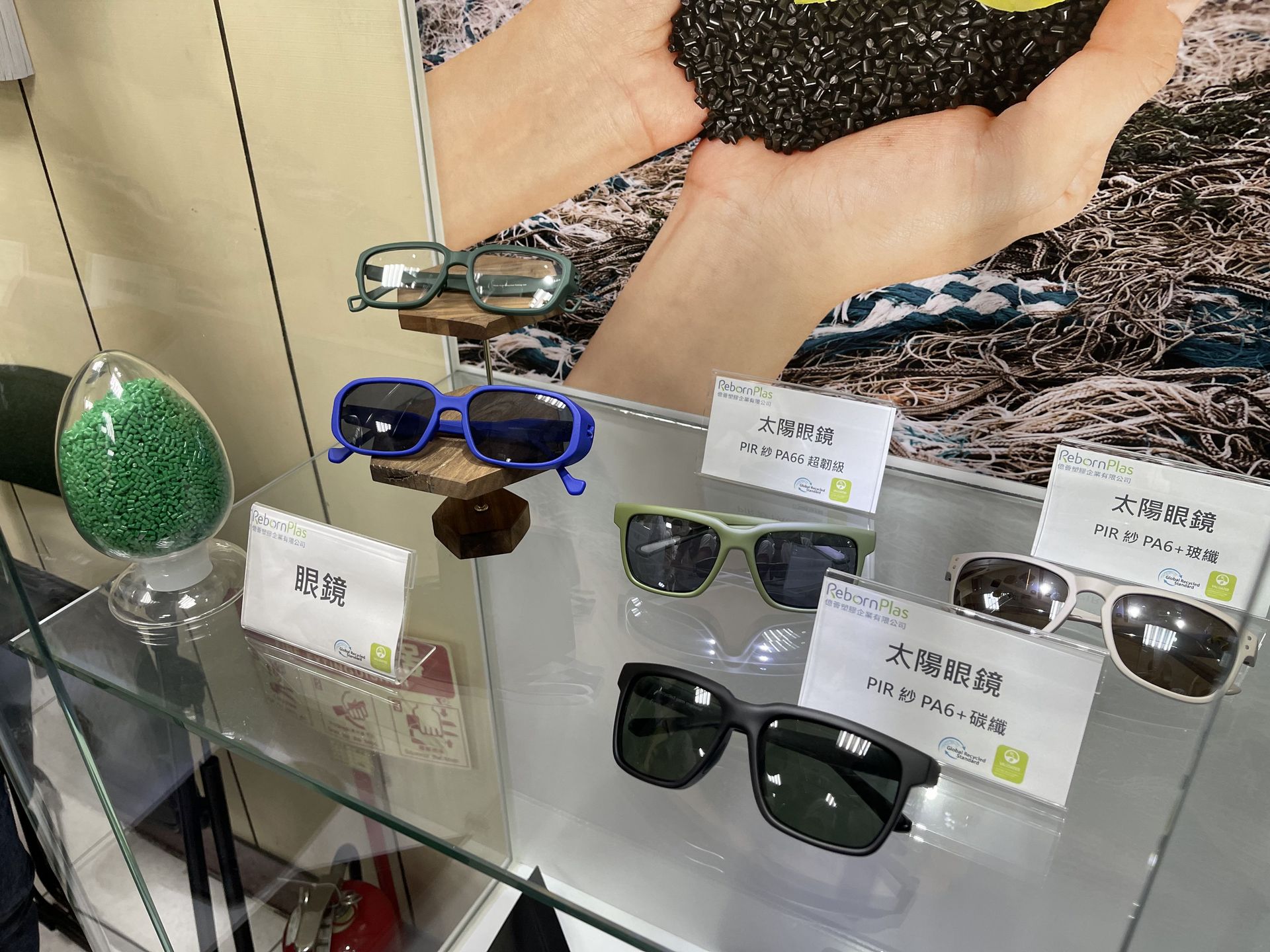
Firstly, the office chair, including all the armrests, back frame, legs, and wheels that you saw, can be produced using the fish net. Office chairs were mainly produced in Tainan and Taipei. The Backbone in Taipei are charity organization too. Almost all of their OEM factories and office chair manufacturing industries in the southern region are our clients, using the materials we provided. We’ve been working in this field for a long time. Then, the eyewear, the earliest eyewear company we work with is Hwa Mei Optical. We also work with the Youyu Glasses brand. As well as bicycles, brands like Giant, many of their OEM factories purchase recycled, certified materials from us, including the American brand Trek. Bicycles are actually one of the industries that strongly represent environmental sustainability; they are willing to use materials like fishing nets, so for us and for their industries, it is impactful. In simple terms, we believe that consumer goods for everyday goods are the area where are operation have been most impactful and effective.
Q9: In terms of practicing the circular economy, compared with traditional industries and emerging industries, what unique strategies do you think your company possesses?
Compared with other companies in the same industry, we have more than 20 years of research and development experience. Some of them may have only entered the cycling industry in recent years due to carbon-reduction issues and the topic of the circular economy. We started doing this kind of work more than 20 years ago, so our research and development abilities are more advanced than those of our peers. For problems that they don’t know how to solve, we can usually tell what additives to use, how to modify or improve the material to solve the problem easily. Therefore, we can successfully trial the materials within 1 to 2 attempts, whereas others might take 4 to 5 attempts and still fail. This is our advantage. Other differences compared to other companies in the same industry are that we currently have the largest number of international certifications among our peers. This includes what we introduced in our PPT, such as GRS, UL 2809, and ISO 14064 and 14067. There are also other certifications, such as California Proposition 65 and PFASS. Certifications are important in international trade. They may say:” Oh, you’re using recycled materials, that’s great! But did you have international certifications?” If you don’t have it, you’re out. Especially when cooperating with an international brand, you need to have certification to have the chance to cooperate. Why do we apply for GRS? This certification has a very special feature: it has a mechanism called a TC(transaction certificate). When you buy materials from us, we can issue a TC transaction certificate to you. Information from both the buyers and sellers, including what materials were purchased and the percentage of recycled content. All of the information that European and American countries need is recorded in the system. For example, the European Union is starting to impose Carbon border taxes next year or the year after. If you don’t have this transaction certificate, your product will either be subject to heavier taxes when entering their country, or you will not be allowed to enter. This is one way we differ from other companies in the same industry. Other companies might not be able to apply for TC. Even if they have applied for GRS, if they don’t purchase materials from an internationally certified source like ours, they are still unable to issue certificates. This is our advantage.
Q10: What kinds of collaborations has your company adopted to ensure the stable supply of recycled raw material?
We had mentioned a bit earlier on the collaboration with organizations such as fishermen’s associations and fishing communities, as well as local governments, to establish such a system. I would like to add that a stable supply required the long-term cooperative relationship with surplus resources, so when they have the resources, they will reserve them for you, or even provide them to you in advance.
Interviewer: So, as you mentioned, you have been doing this for a long time, so you have established these relationships?
Yes. Resources such as marine debris and fishingnets are largely under our control for now. Firstly, these resources are hard to process. Secondly, we control the resources. This is also one of our advantages. There are also companies overseas doing marine waste fishing net recycling as we do, and there are quite a number of them. Many of them are in much larger scale than us. Therefore, to secure those resources, we need to hold on to them. That is to say, no matter whether we encounter the pandemic, a financial crisis, or even large scale impact such as Trump’s tariffs, we still need to bring in a fishing net monthly to maintain control over the resources. We hope to stabilize our supply sources through these long-term cooperative transactions.
Q11: You mentioned earlier that there have been collaborations with government agencies and certain organizations. Would you be willing to share the most memorable collaboration?
We are a funding member of the Marine Debris Recycling Coalition, and we still are today. The government renamed itself the Ministry of Environment. If I remember correctly, the Marine Conservation Administration has already changed its name. Since joining the alliance, we have remained members. Major brands, both domestically and internationally, including a delegation from iPad member countries, previously visited us. In fact, government units, including the Industrial Technology Research Institute or the Ministry of Environment, treat us as a model case. They often bring foreign visitors or corporate groups to our site to see how we carry out this type of recycling business. This is our corporation with the government. As for the experience that left the deepest impression, it was our collaboration with a certain major laptop manufacturer. Sorry, this cannot be disclosed to anyone because we signed an NDA, they don’t allow us to talk about it. We work with them. The material they want to use is new and of high quality. Yes, we went through more than twenty rounds of materials trials back and forth. We really wanted to get our material adopted. Their products truly have extremely high performance requirements, and it was genuinely difficult. During this process, other large manufacturers also tried to participate, including major companies such as LG from South Korea or KingFa from China. KingFa is a company that is supported and backed at the national level, and of course, its scale is much larger than ours. However, these companies withdraw after fewer than three to five trials. They felt they could not continue because the requirements were too difficult to meet. On the other hand, we did not give up and continued to conduct trials with this laptop manufacturer. We even personally flew to their original Design Manufacturer factory in China to accompany them during the trials. This was essentially our first time entering the 3C electronics industry. These are the experiences that left a deep impression on me.
Q12: How does your company collaborate with younger generations or educational institutions to promote knowledge about recycling resources?
For our generation, it is impossible to see the concrete results of carbon reduction and the circular economy in the short term. The results will only be shown in your generation, so we hope that our next generation, or young people like you, can understand the importance of doing these things as early as possible, the earlier, the better. Practicing the circular economy requires a very, very long time before you can see the results, and because of how long it takes, some companies are still observing and hesitating. They ask, “Do we really need to do this?”“When will we break even?””Will my company even survive?” People will ask whether they can take care of these issues while making money. This is the challenge we are currently facing. This is why we hope that young generations can realize the value of doing these things as early as possible. Besides having a cooperative program with schools, social media today is well developed, and the younger generation is inseparable from social media in their daily lives; therefore, providing information and innovation on these platforms to increase understanding of this field would be useful. Another aspect is whether there can be cross-industry collaborations or co-branding projects. For example, brands like Hibang Eyewear made eyewear using recycled material, and they cooperate with Hwa Mei Optical. Hwa Mei Optical may produce, for instance, co-branded editions for events like the World Baseball Classic. Tactics like this can allow young people or consumers to understand that “the glasses I bought are actually made from fishing nets.” We need to plant the idea into the minds of consumers and manufacturers, so they develop that awareness. This is the biggest driving force, in addition to government regulations. Also, how young generations use social media platforms is important now, and how can we help them understand why we are promoting the circular economy. Nowadays, the climate is becoming extremely abnormal: when it is hot, it is very hot, and when it is cold, it is colder than before. This is happening because carbon emissions are escalating. We must reduce carbon emissions, and using recycled materials can reduce carbon emissions significantly. This is the ultimate purpose of why we recycle materials.