Data Analysis

Image Source

Background

Through studying the public's understanding in recycled materials and environmental concerns, this questionnaire aims to reflect the public's opinion towards the topic. Conducting quantitative data research could obtain information and statistics that cannot be proven by qualitative research, providing an objective view on our society and community. In this form, we focus on environmental issues and recycled products to explore their penetration rate in our society. Overall, through this survey, we wish to have a more complete scan on the world around us and how we unite and contribute to obtain a sustainable community as a whole.
Out of our 82 respondents, most of our survey participants are female junior high students under the age 14 (73.2%) from Kang Chiao International School. 

Data & Analysis

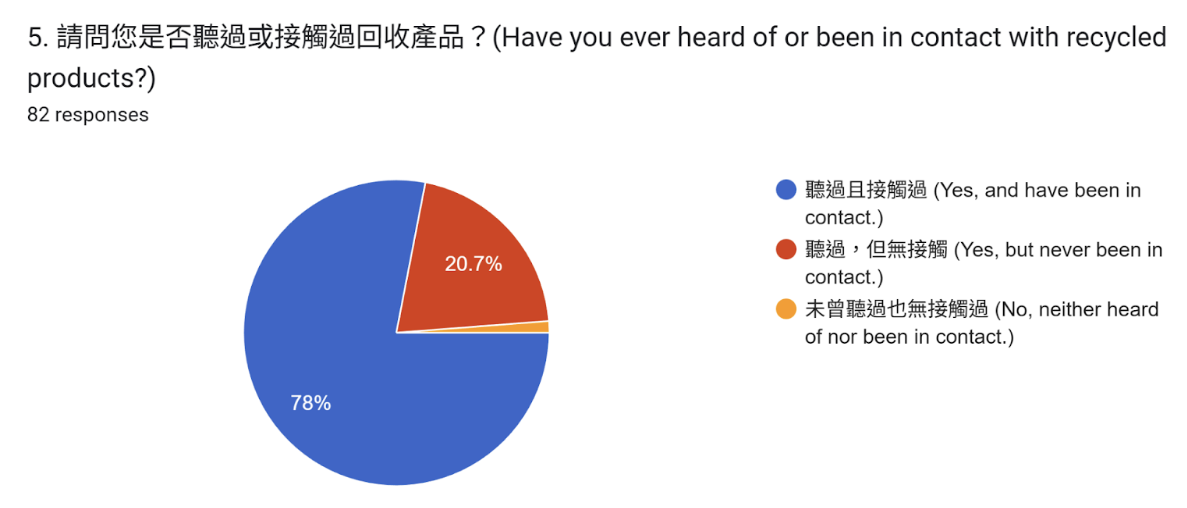
This chart visualizes the penetration rate of recycled products. In the survey, most of our participants, 78%, are familiar with these products and use them in daily life, while 20.7% of them have heard about them. A minority of the respondents have never heard and been in contact with these products. This analysis showcases an optimistic view on our steps towards sustainable production and consumption.

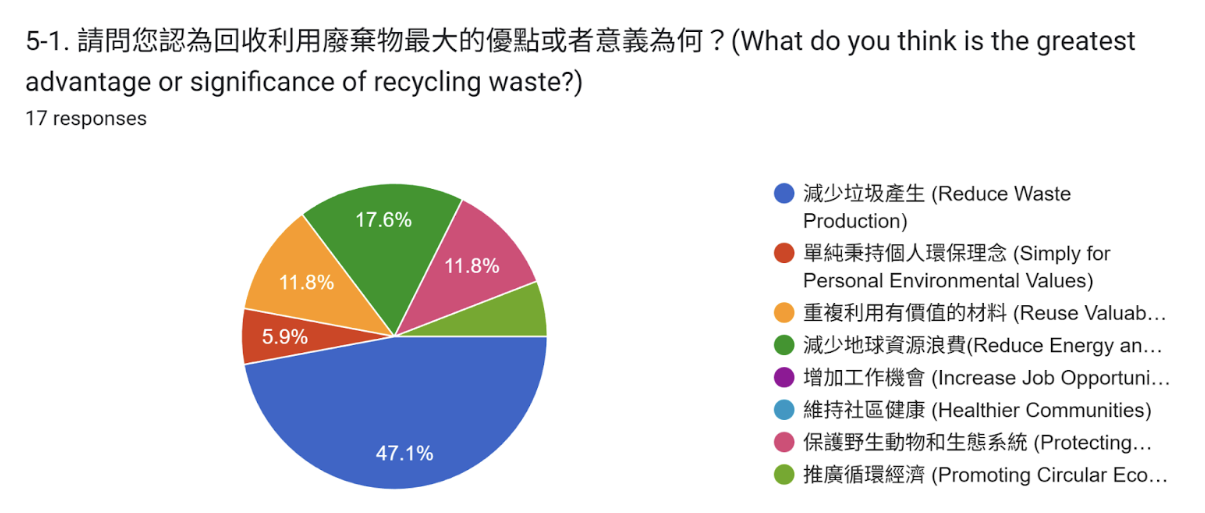
This question aims to explore people's opinions towards the purpose of recycling. Almost half of the respondents believe that recycling could reduce waste and improve the environment. Other minor options include protecting wildlife and ecosystems(11.8%), reducing energy and material consumption(17.6%), reusing valuable materials(11.8%), and personal values(5.9%). This reflects that the public believes recycling is aimed for environmental benefits.

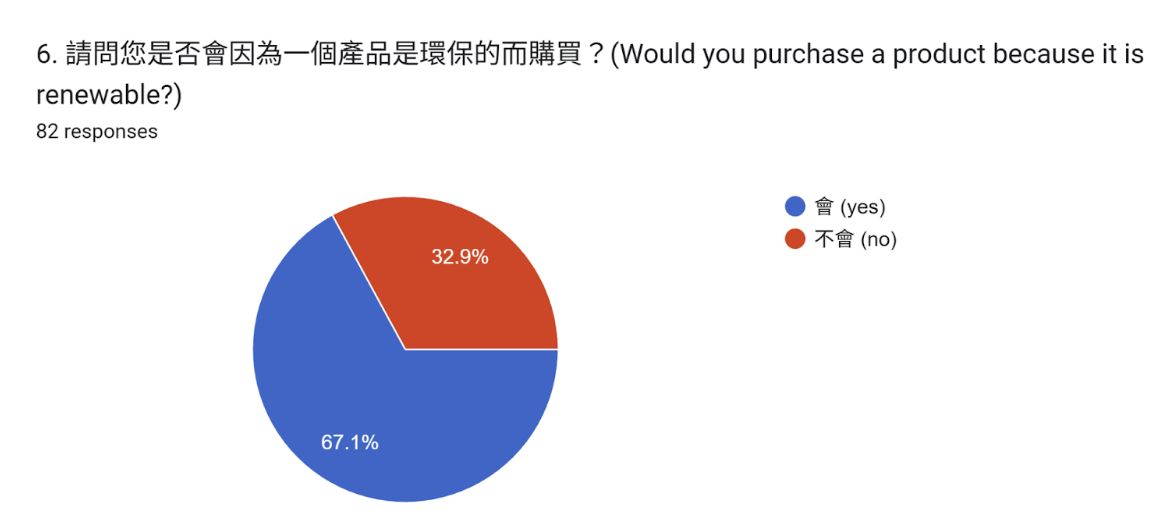
About ¾ of our respondents(67.1%) show care and attention to eco-friendly contents when purchasing products, while 32.9% have a neutral stance. From this proportion, we could see that the public's awareness towards environmental issues are highly concerned.
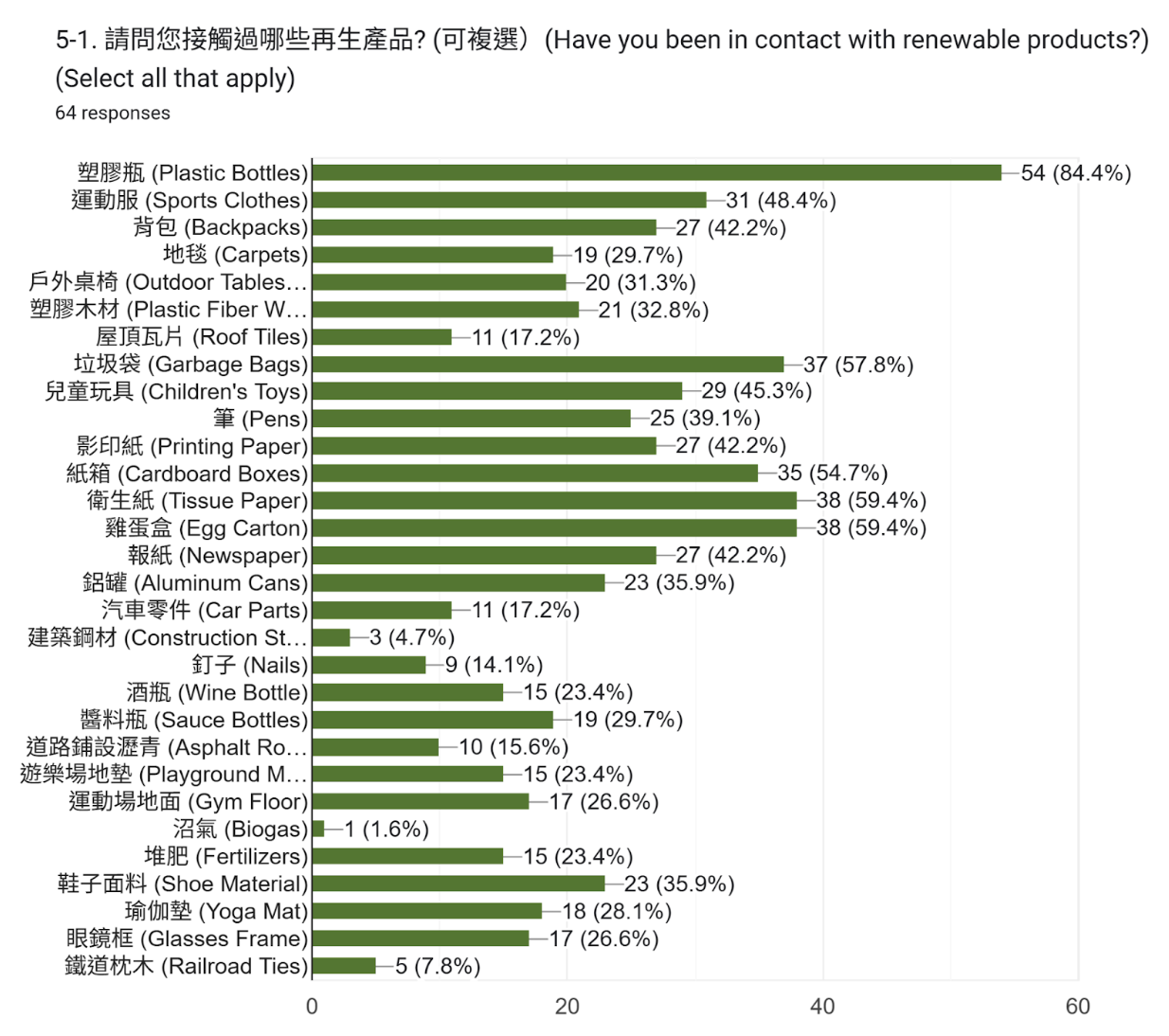
In this inverted bar graph, we could see the popularity among the various recycled products. The most popular product is plastic bottles, which is already a common daily equipment in our society. Additionally, garbage bags, tissue paper and egg cartons are also common choices, showcasing the high penetration rate of recycled paper and plastic products in Taiwan.

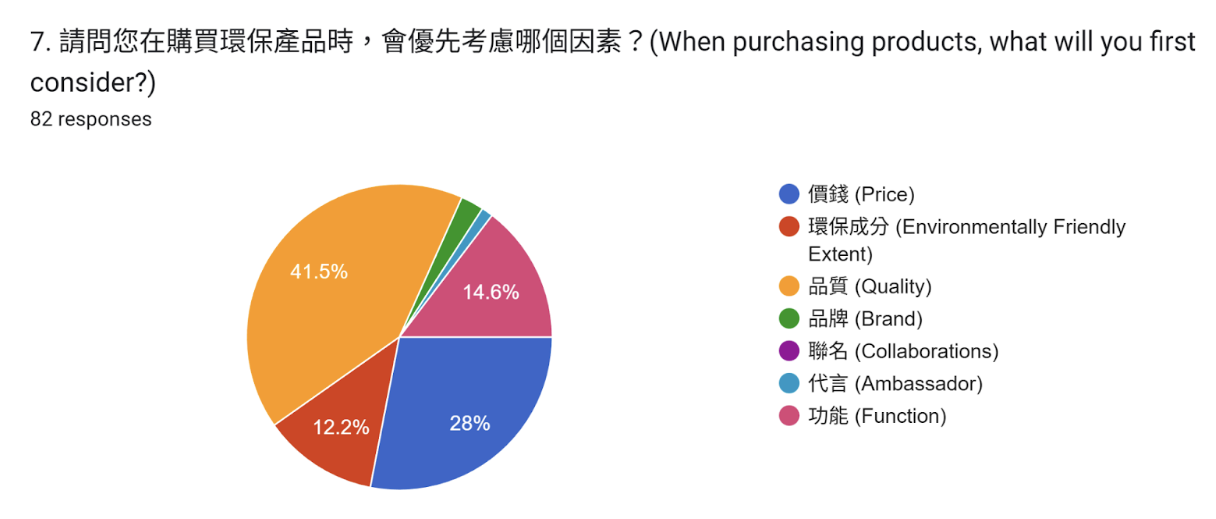
Following the question above, we extend the question to "When purchasing products, what will you first consider?" to explore the elements industries need to consider while marketing to appeal to the audience. Most of the respondents reflect high attention to the product's quality(41.5%) and price(28%), showing the crucial relationship between the two elements: being cheap while excellent in quality. This two-way significance is one of the important aspects companies need to be aware of while promoting environmentally friendly products.
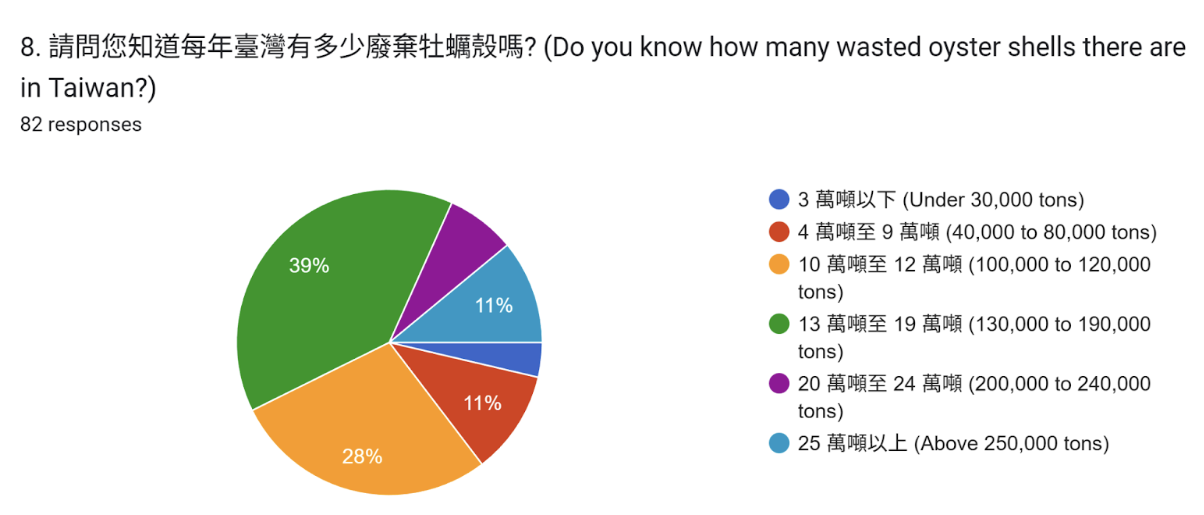
This question aims to explore the public's awareness towards the environmental issues in Taiwan: piling of oyster shells. The correct answer of the question is 130,000-190,000 tons(precisely 160,000 tons), and 39% of the respondents answered accurately. The large percentage of the wrong answers shows the need for promotion to raise public awareness towards this issue.

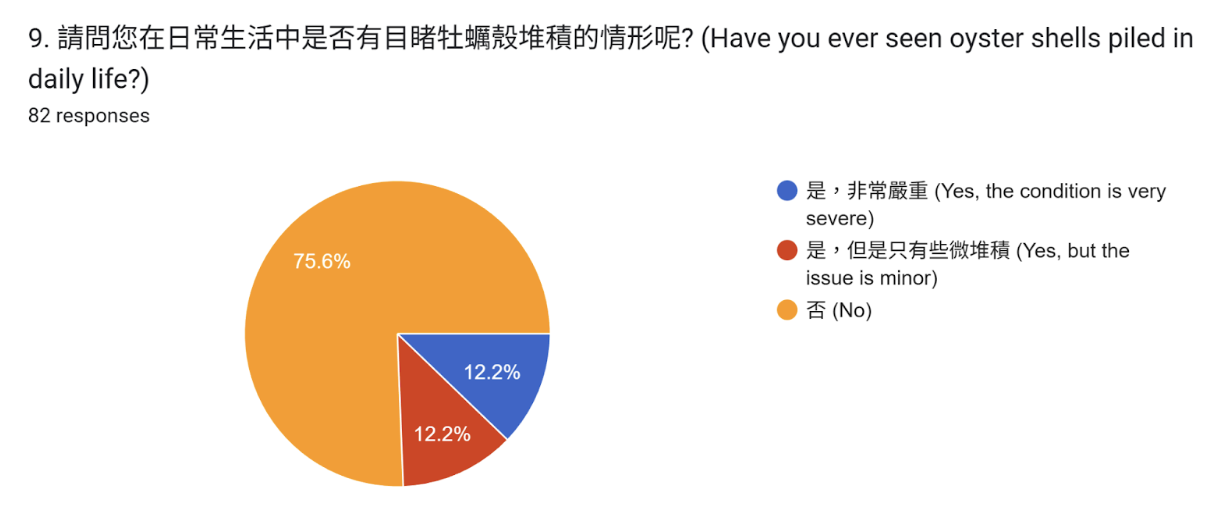
Most of our participants reported they have no experience of witnessing the issue(75.6%). This is due to the location of the piling mostly in countrysides and shores, which is far from the cities most of our students live. This also showcases the efforts towards resolving this issue has visible progress.

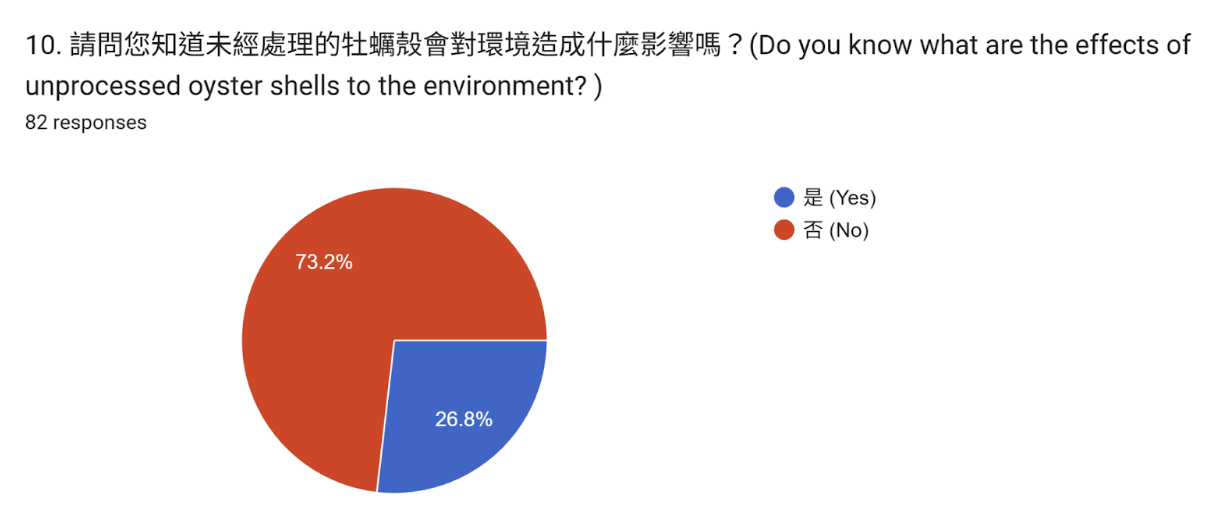
In this question, most respondents(73.2%) reflected their lack of knowledge towards the severe consequences of oyster shell piling. The majority showcases an urgent need to raise awareness towards this issue in order to make a bigger change.

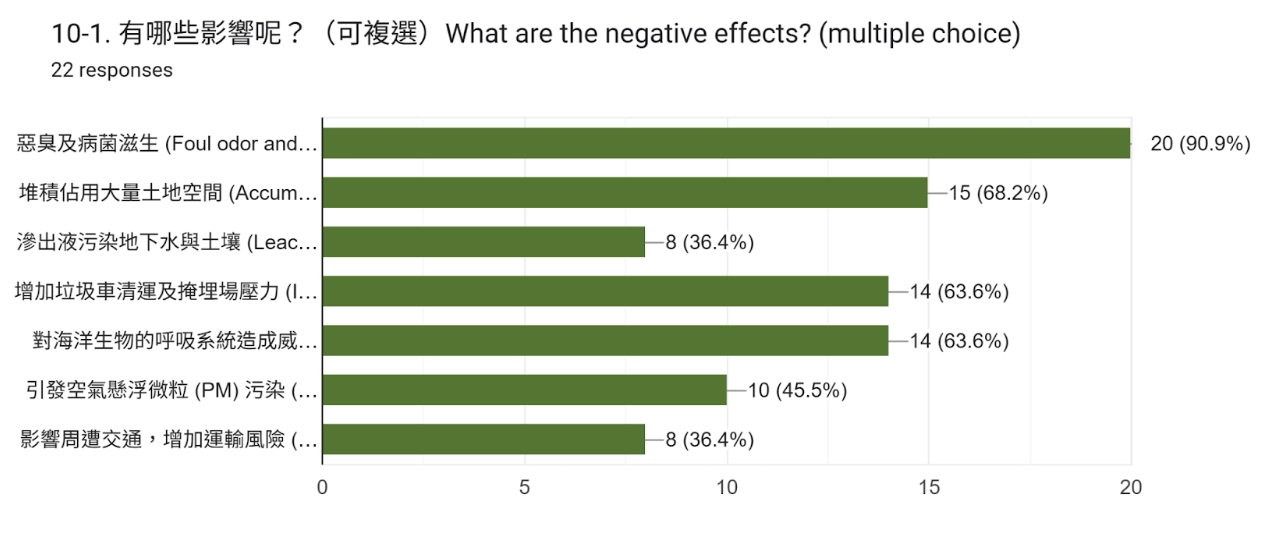
This question further extends to test if the participants that answered a yes in the previous question have deep understanding towards the negative effects. Most of the participants(20, 90.9%) chose "Foul odor and proliferation of pathogens/bacteria", showing their care towards consequences that directly impact the public's health and well-being.

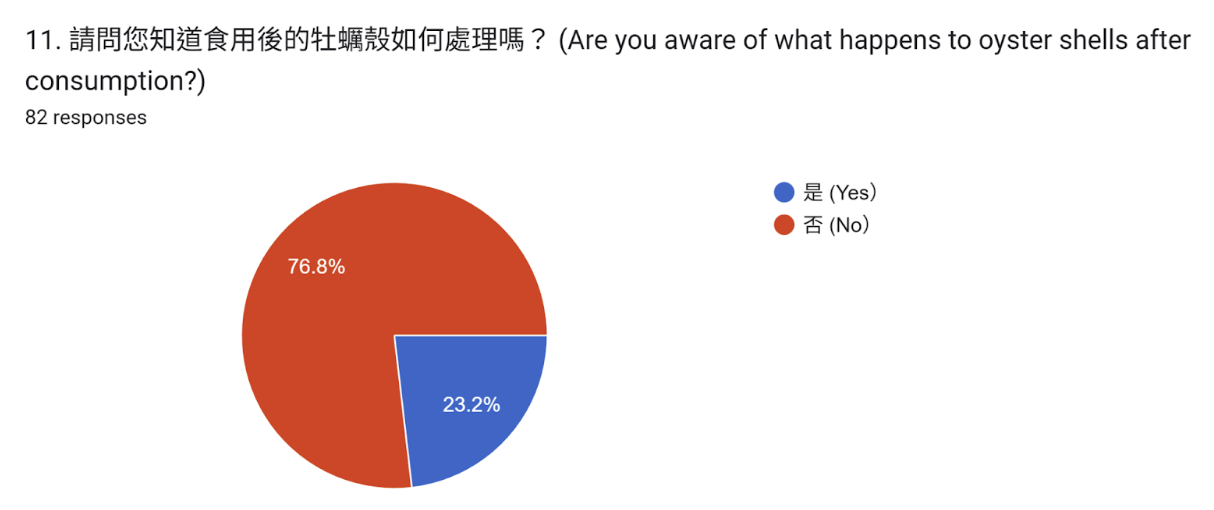
Since oyster is a common food culture in Taiwan, we are curious as to how many Taiwanese people are aware of environmental concerns after consumption. In this question, 76.8% of respondents do not know where the shells go after they throw them away, while 23.2% are aware. This shows that the majority of the public lack the knowledge and motivation to contribute and explore environmental issues.

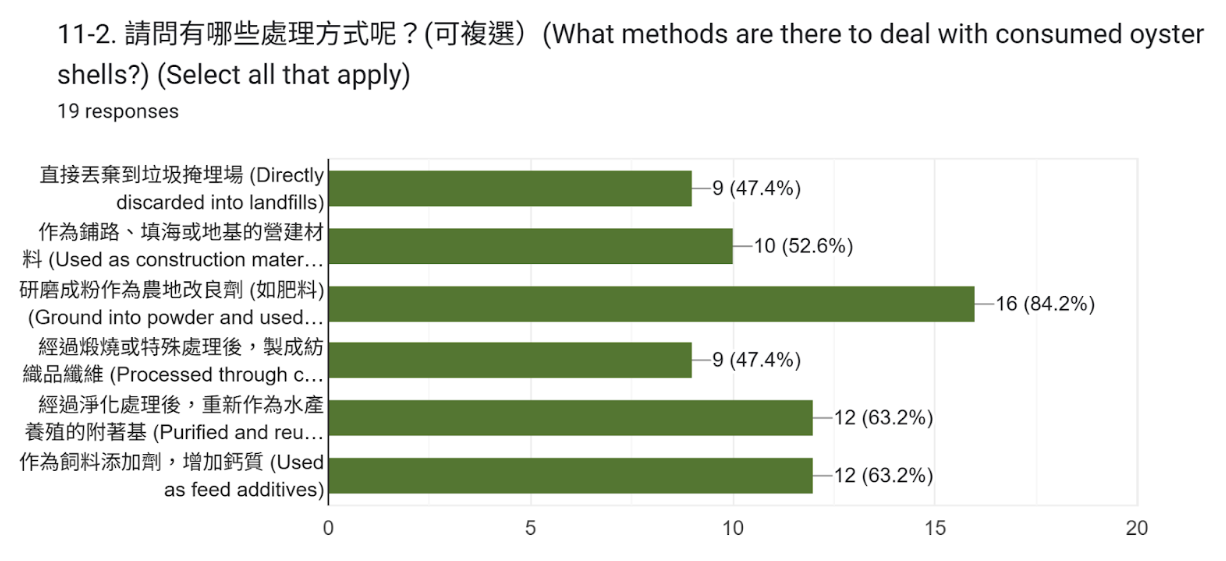
In this question, we inquire the respondents' knowledge about the ways to deal with oyster shells. Unfortunately, 9 of the respondents answered "directly discarding the shells into landfills". Though this is the most common solution, it is extremely harmful to wildlife and the land. The most common choice was "Ground into powder and used as an agricultural soil amendment (e.g. fertilizer)", showing the connection between agriculture and oyster shells. This usage is one of the former functions, while in recent years there are new technologies introduced that are less known. Therefore, this question's results confirms the need to promote turning oyster shells into recycled products as we aim to in this project.

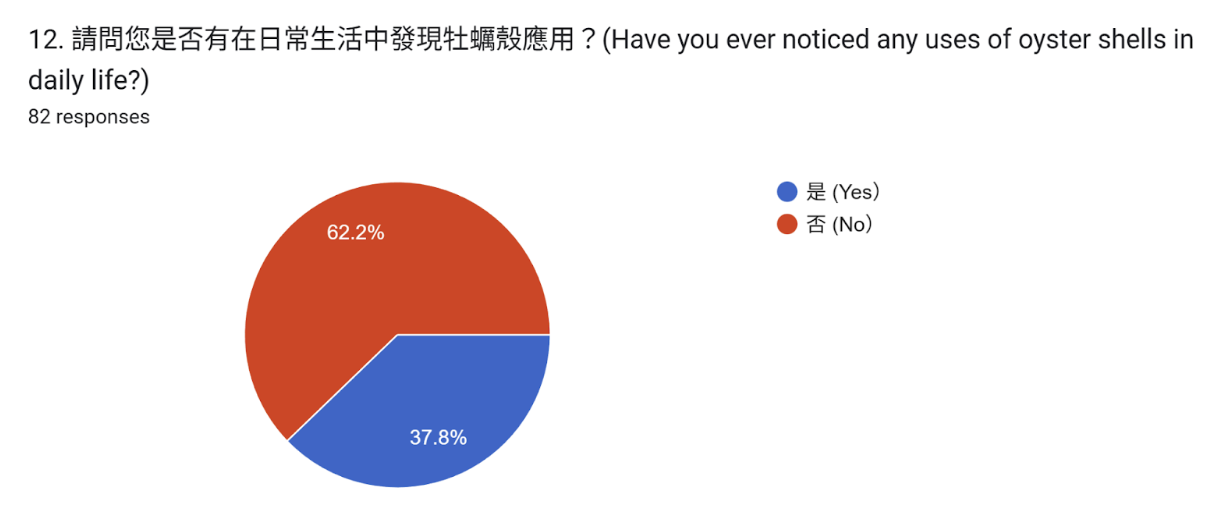
In question 12, we explore the penetration rate of recycled oyster shell products in daily life. More than half of the respondents(62.2%) responded a no, while 37.8% answered a yes. This demonstrates the journey of promoting oyster products still has a long way from making it common and adapt in our society.

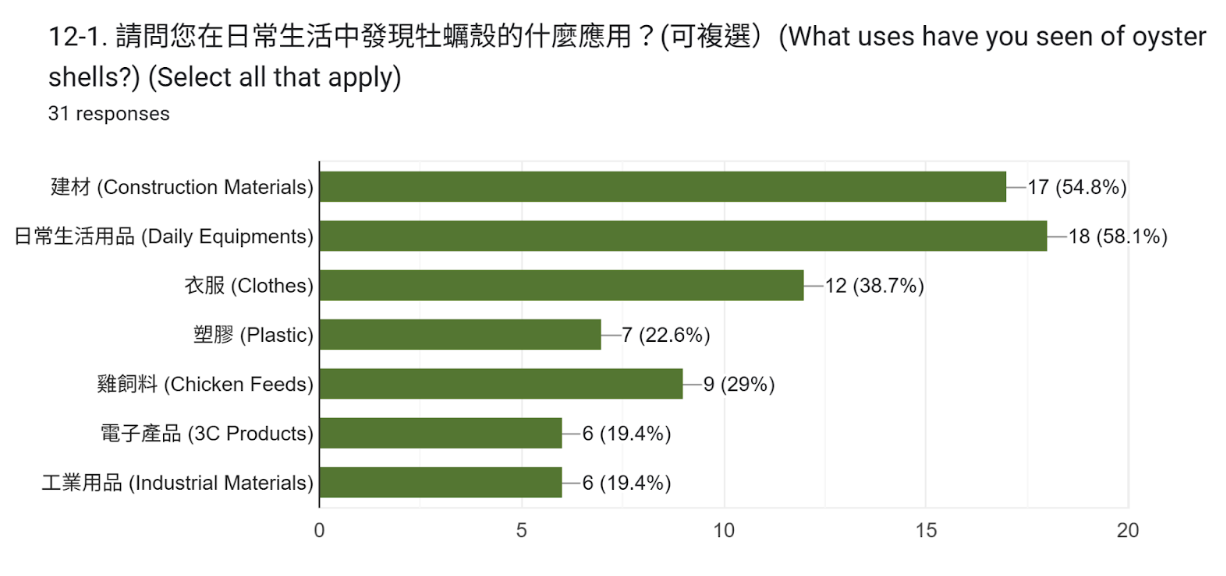
This question further inquires how oyster shells are used. Most of the participants responded with construction materials(54.8%) and daily equipment(58.1%). This shows that recycling industries start with products that are closer to people's lives in order to adapt the material entirely to society.

This question further inquires how oyster shells are used. Most of the participants responded with construction materials(54.8%) and daily equipment(58.1%). This shows that recycling industries start with products that are closer to people's lives in order to adapt the material entirely to society.

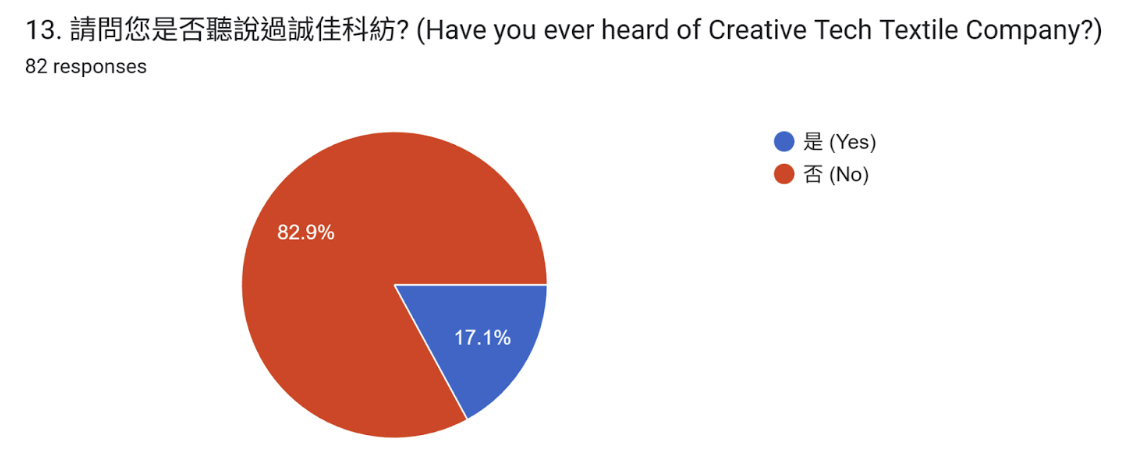
In this question, we investigate the marketing effectiveness of Creative Tech Textile Company by exploring their popularity in the society. 82.9% of the respondents never heard of the company, while 17.1% had. This shows that a large proportion of the public do not know about their works and efforts, demonstrating a need for eager promotion.

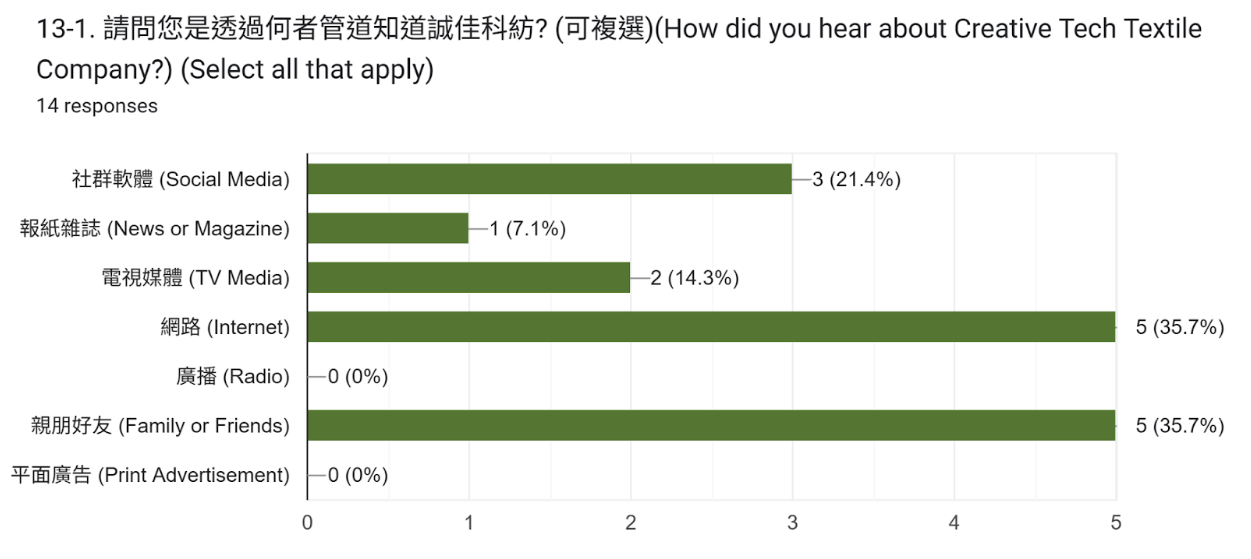
Most of the participants that have heard of the company knew it from the internet and print advertisements(35.7%). Therefore, these two methods are the most effective ways of marketing. By advertising the company with these two ways, we could increase the supporters and customers for the company, allowing more citizens to have access to eco-friendly clothing.

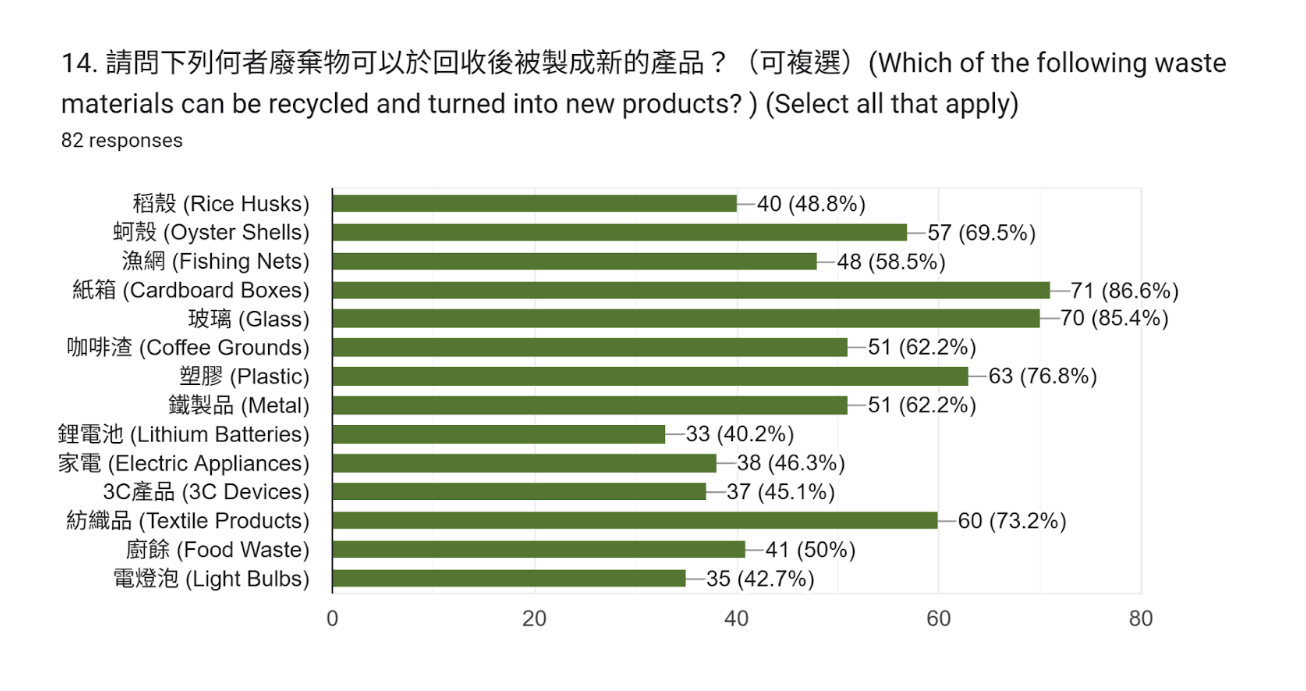
In this question, we explore the respondents' knowledge about recycled products. Most common materials include: cardboard boxes(86.6%), glass(85.4%), plastic(76.8%), and textile products(73.2%), while oyster shells have a decent percentage of 69.5%, showing the progress of oyster shell business and recycling industries towards a sustainable market.

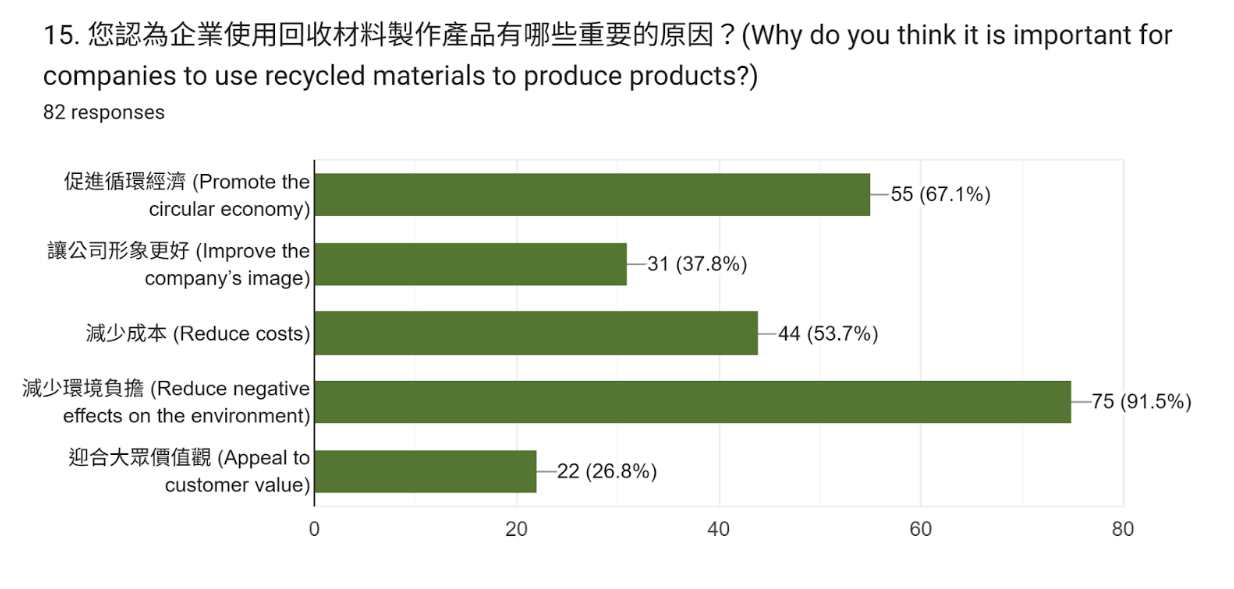
In this question, we ask our respondents about their opinions of recycling products' impact towards the company. Most participants believe that the main purpose is to "reduce negative effects on the environment"(91.5%). This shows their genuine care towards our ecosystems and wildlife, providing an optimistic aspect on the public's awareness of environmental concerns.

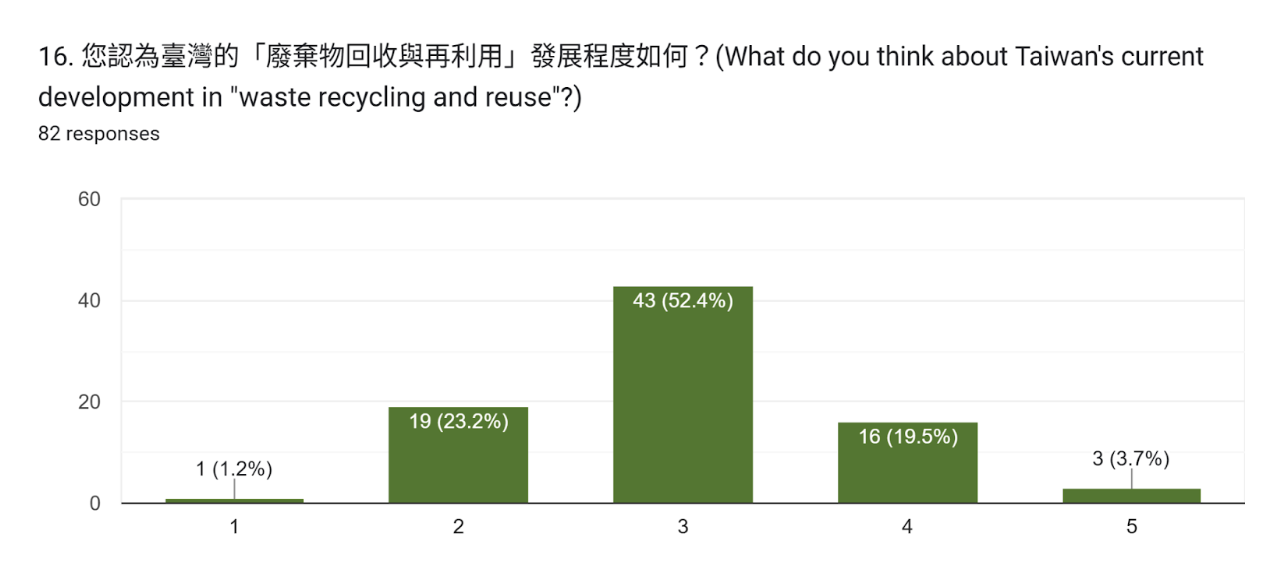
In this question, we explore the public's opinion on Taiwan's development in sustainability. Most participants have a neutral stance in this topic, responding with a 3(52.4%). The data showcases a triangular distribution, showing that Taiwan is still developing.

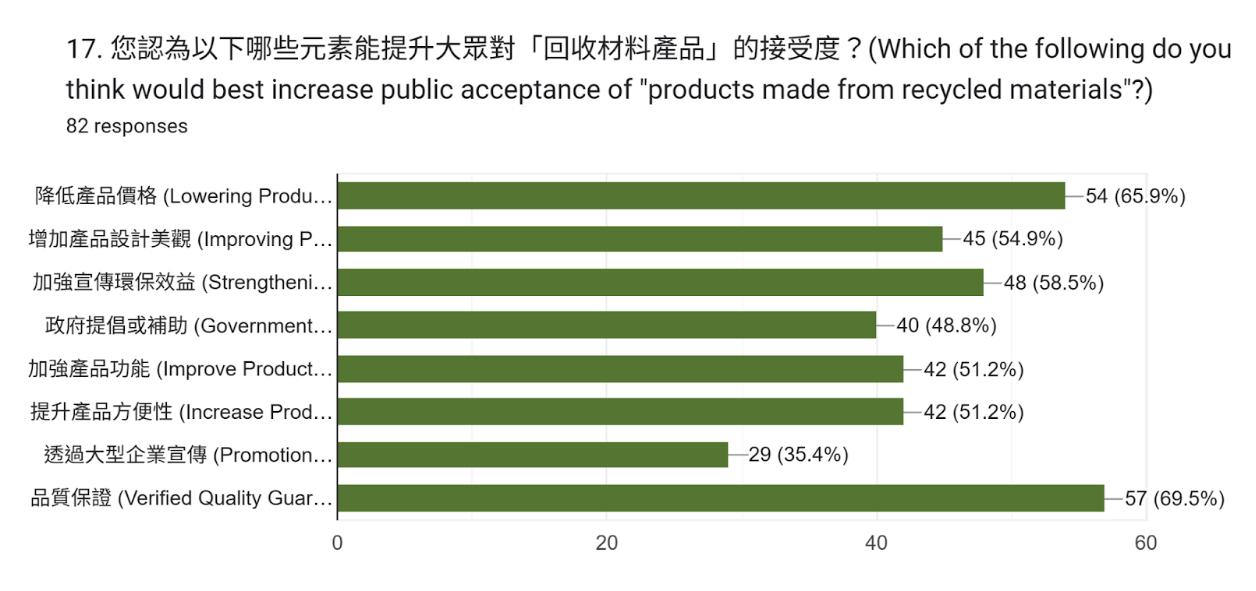
In this question, we dive in depth to explore how we could increase the popularity of recycled products. Most of our participants responded with "lowering product price" and "verified quality guarantee", aligning with the elements in question 7. We could see that quality and price are very significant factors of a product.

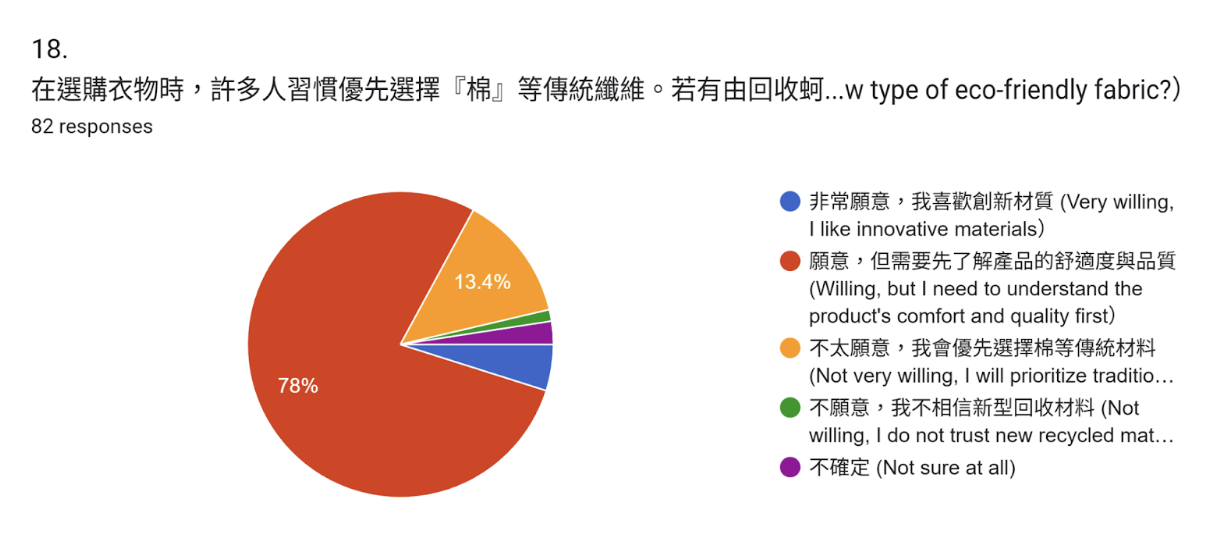
In this question, we explore how open the public is towards new materials. Most of our participants(78%) responded with "willing, but I need to understand the product's comfort and quality first", showing that they care about the product itself rather than whether it is a brand new material or not. However, 13.4% of the responders reflected that they dislike new materials and would prioritize traditional cotton. This shows a great obstacle in making the majority of the clothing eco-friendly when some of them resist new materials.

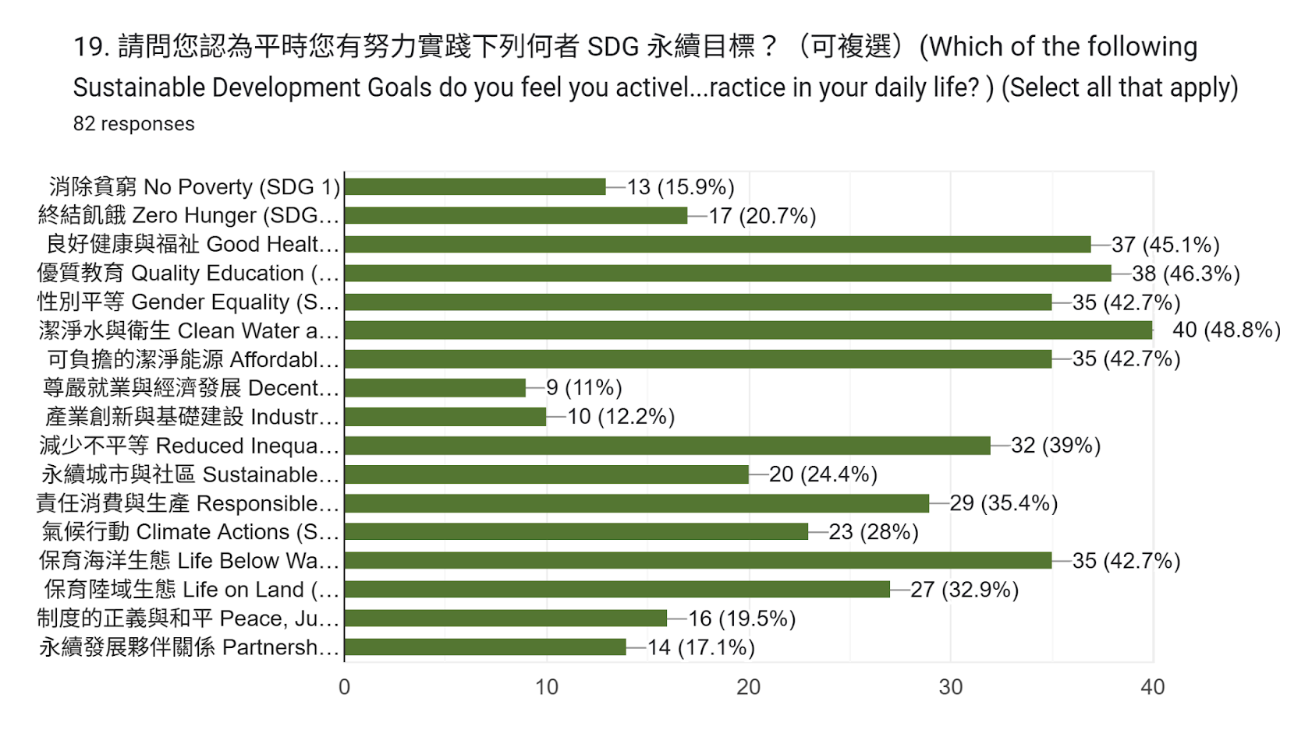
In this question, we survey the activeness of the public in achieving general SDGs goals. The most common goals achieved are good health and well-being(45.1%), quality education(46.3%) and clean water and sanitation(48.8%). Considering most of our respondents are teachers and students, they have visible progress in the goals reachable for them.

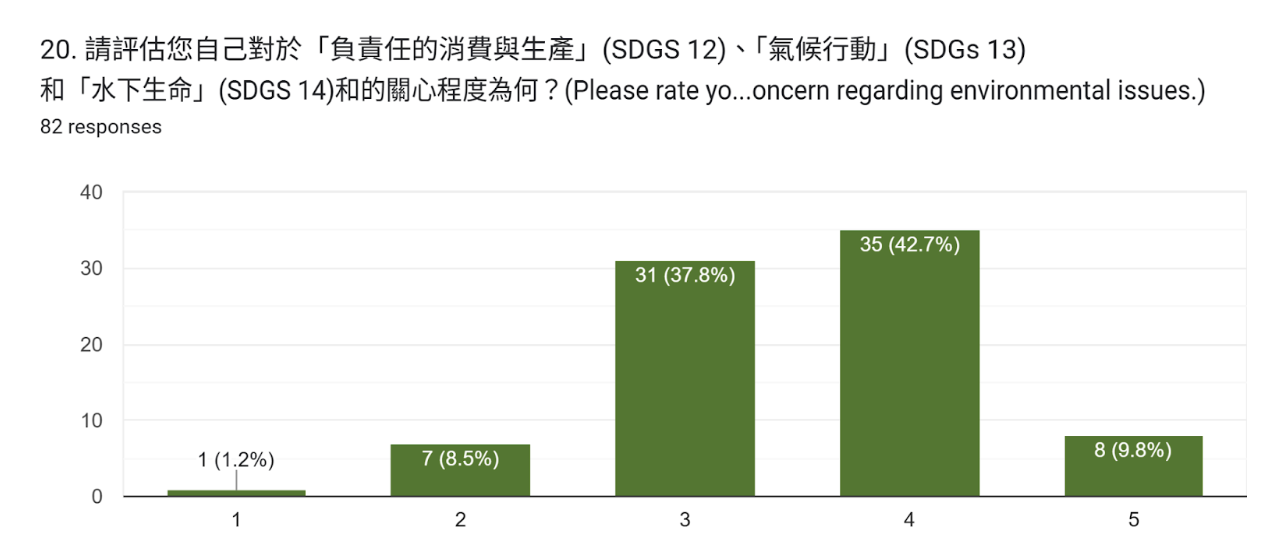
Most of the participants answered 3(37.8%) and 4(42.7%), showing that most people have attempted to contribute to these three SDGs goals.

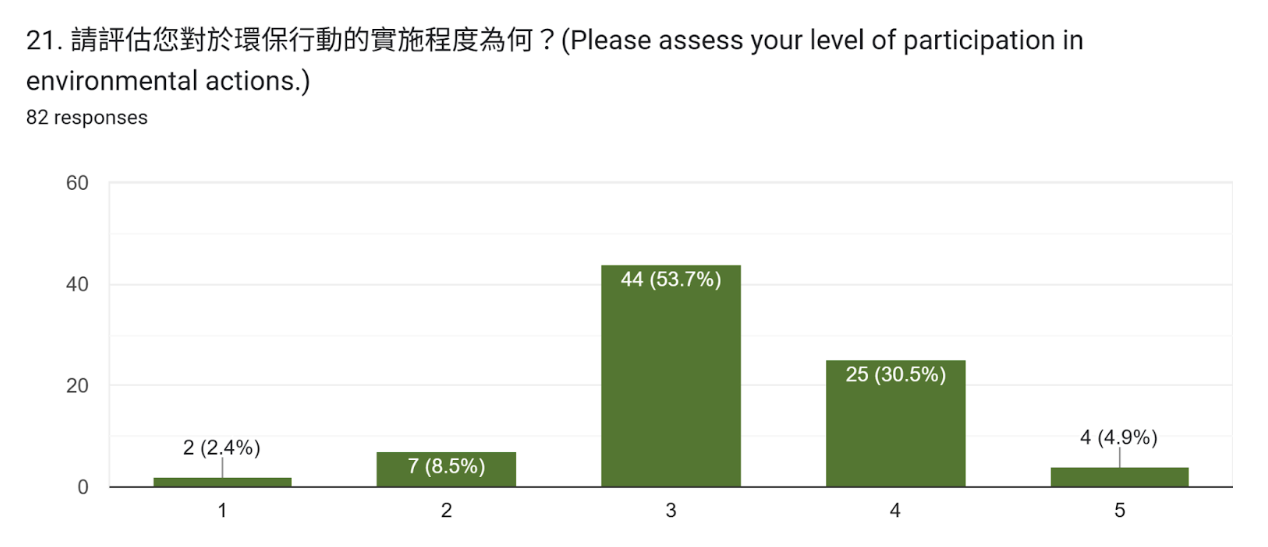
In this question, we explore the levels of participation the public has played in environmental actions. The data showcases a triangular distribution, showing that most of the respondents have started to be aware and act on environmental concerns.

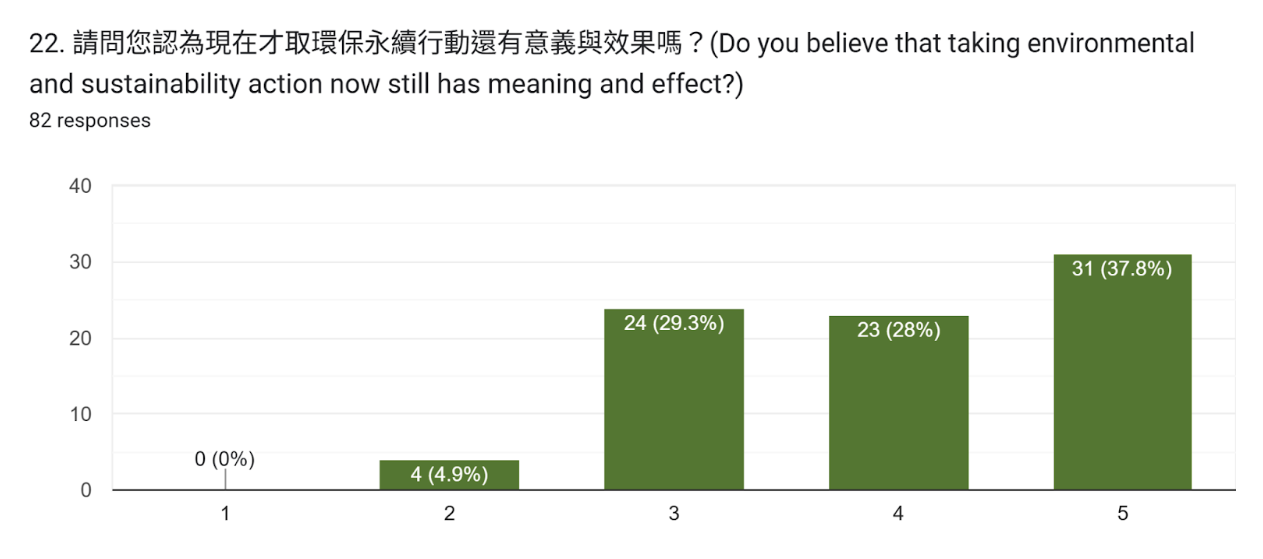
In this question, we inquire the public's opinion towards current environmental actions. Most of the participants(37.8%) have an optimistic attitude (rating a 5) towards our environment and believe that every action still matters.

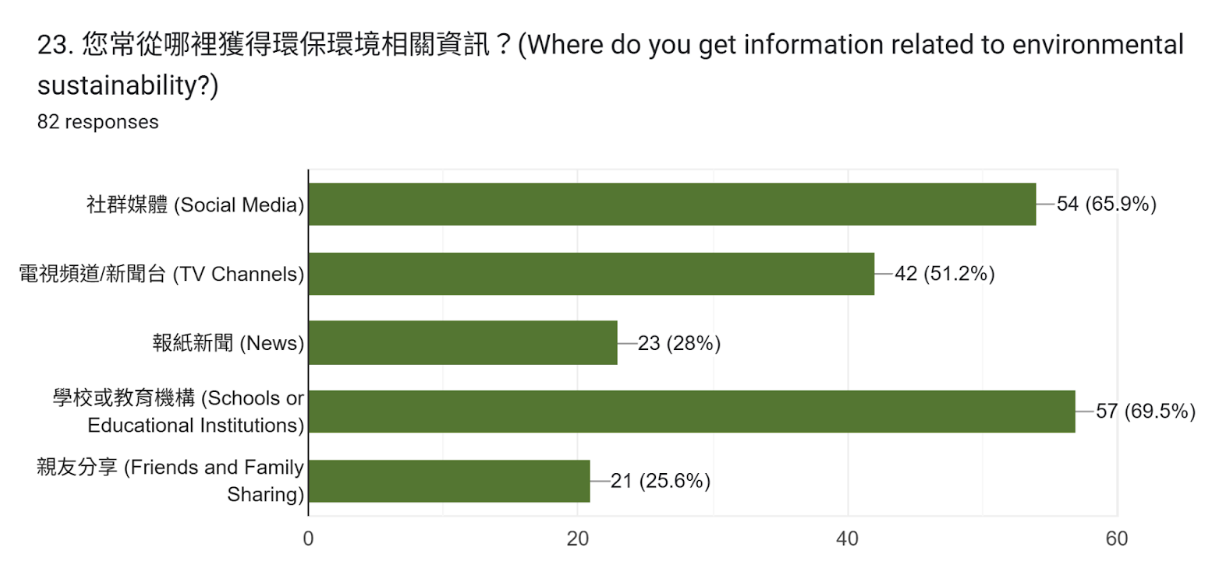
In the last question, we investigate the best source for raising environmental awareness. Most of the participants got their information from social media(65.9%) and educational institutions(69.5%). This survey highlights the importance of schools and media platforms for positive changes to our environment.

Conclusion

Our research, through statistics and opinion collection, highlights a strong environmental consciousness and a critical gap in public knowledge of specific innovations and creativity. While consumers are willing to purchase recycled materials, they still have concern towards the quality and price of items, forming an obstacle on the way to sustainability. Many are still unaware of the marine and air pollution crisis that is happening in their own backyards. To step into a sustainable community, it is crucial to educate citizens and raise awareness through media platforms. This could spark new innovation while preparing citizens with an open mind towards new recycled products. Ultimately, transforming a discarded shell into a sustainable product is possible, but it requires turning public awareness into active, informed consumer choices.